
Deuteronomy 34:1-12 and Psalm 90:1-6, 13-17 | Leviticus 19:1-2, 15-18 and Psalm 1 | 1 Thessalonians 2:1-8 | Matthew 22:34-46
The Pharisees are giving it one last go to debate it out with Jesus. They send their best and brightest Bible teacher into the ring to see if this preacher from backwater Nazareth can hang with Jerusalem’s finest.
The Bible teacher goes first: “Which commandment in the law is the greatest?” The question is meant to expose Jesus to criticism over the commandments he doesn’t pick, but in and of itself it’s a crucial question that Jesus takes seriously. The Bible is a big, complicated, ancient book that confounds us in many ways. How do we know which parts are the most important? How do we discern what to do when passages seem to offer contradicting wisdom? The Scriptures we center change how we live, what we understand to be good, and who we understand God to be. Where we focus our attention matters a lot!
So how do we know what teachings to center our lives on? Today Jesus offers us an answer: “You shall love the Lord your God with all your heart, and with all your soul, and with all your mind.’ Here he quotes from the shema, a passage from Deuteronomy 6 that Jews in Jesus’ day and our own hold so dearly they recite it morning and night. Then Jesus offers a second “like it” from Leviticus 19: ‘You shall love your neighbor as yourself.’ And on these two pegs he hangs all the law and prophets and brings them into unity.
Jesus’ framing presents “not just an exhortation to occasional loving acts but a societal vision,”1 a vision that includes – according to the rest of Leviticus 19 – respect for parents, keeping the sabbath, feeding the poor and the foreigner, not lying or stealing, paying just wages, not reviling the blind and lame, not swearing falsely in God’s name, not spreading slander, not seeking revenge. By bringing Deuteronomy 6 and Leviticus 19 together, Jesus defines fulfilling the law as a whole way of life, a web of relationships ordered in God’s vision of community.
But the Temple leaders have failed to bring about God’s societal vision: they’ve encouraged people to give money to the Temple instead of supporting their aging parents, have made the Sabbath a heavy burden, have banned the blind and lame from entering the Temple, and now they seek revenge on Jesus’ very life. In Matthew’s next chapter, Jesus will shout “Woe to you, teacher of the law! You give a tenth of your spices—mint, dill and cumin. But you have neglected the more important matters of the law—justice, mercy and faithfulness. You blind guides! You strain out a gnat but swallow a camel.” (23:23) The religious leaders have cared more about being right than about living in right relationship and so they have failed to love the Law Giver; they have hung their lives on the wrong pegs.
People have a tendency to turn God’s law into a way of establishing their moral superiority over others. But Jesus reveals that the law is meant to bring us together, he shows us how love for God, self and neighbor fulfills the law. We don’t follow the law because it saves us – God alone can save! Yet the way that God saves us is through his life giving ways given in the law because God is love and God’s ways bring wholeness and life. Like a tree planted by streams of water, which yields its fruit in season and whose leaf doesn’t wither is the one who meditates on God’s law day and night, says our Psalm today. The law, fulfilled through love for God and neighbor, gives sustaining life.
Hauerwas writes, “We know what it means to love God only because of God’s love for us through the law and the prophets.”2 Jesus does not call us to love some god-in-general or the idea of ‘love,’ but to love “I AM” your God. “I AM” who brought the people out of Egypt. “I AM” who sent the prophets to call God’s people to return to Him. “I AM” who loves His people and longs to be with them, to have mercy on them. We are called to love God as revealed to us in the Scriptures, most fully in the Word made flesh, Jesus. Thus disciples of Jesus must take obedience to God’s Law seriously. The key, according to Matthew, is to follow it as interpreted, taught, and fulfilled by Jesus.
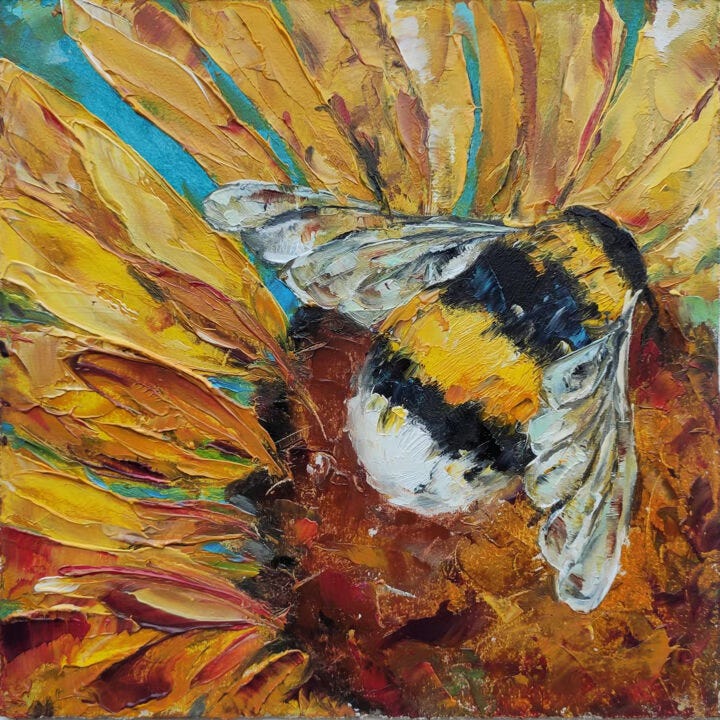
Jesus’ interpretation brings God, neighbor, and self together. When a nursing mother cares tenderly for her child and feeds him (an image Paul uses to describe his relationship with the Thessalonians in our epistle) is she loving her neighbor (the baby) to whom she gives nourishing life? Or is she loving God by using the gifts God has given her for the sake of another? Or is she loving herself as she spends time with someone she loves and gets relief from the pressure of excess milk? Is the bee loving herself or her neighbor as she pollinates the wildflowers? The love that Jesus describes makes such competitions between self and neighbor irrelevant. Being a person of love apart from God or neighbor is impossible. God is love and has created us for love. God’s story through the law and the Prophets – most fundamentally in his prophet Jesus “forms us into the kind of people in whom God’s love can take shape; it transforms us so that we can become capable of love.”3
In 2019, Pope Francis ordered the Migliori mansion neighboring the Vatican to be transformed from a fancy hotel into a shelter for the shelterless.4 It houses 50 folks welcomed by name each night and fed courses of pasta, roasted pork and fresh fruit. They gather for evening prayer before supper in the chapel. A doctor comes in once a week to check on residents. Those who prepare the meals sit and eat with the community and chat in the hours before bed. There is room to come to know the others and even to trust them.
“God is good,” says Anna, a resident there. “He, the big father, saw this little thing falling down, and he picked me out and put me here. Without any important reason either. Because I didn’t do anything so great to stay in a palace next door to the pope! Like a princess, oh my.”5 As Anna is loved by God and neighbor, she becomes more whole, more herself. Liberated from the raw need for shelter and a shower, she can spend time loving those around her and so the circle of neighborliness expands, God’s kingdom comes.
When Jesus brings together the commands to love God, self, and neighbor, he does more than show us how to read the Scriptures – he creates communion: a community of love. Just as the Trinity is Father, Son, and Holy Spirit, three persons in constant giving and receiving, whose love overflows with life for the world, so too as we love God and neighbor we, like Anna, reflect the God in whose image we were created. We seek healing and wholeness, we live with mercy just as God has been merciful to us and God’s vision of a just and loving society grows. We learn to love by being loved, for loving God and neighbor overflows from the way God first loved us!
// Our passage today concludes with Jesus asking the Pharisees, “What do you think of the Messiah? Whose son is he?” It’s an easy answer, and the Bible Teacher gets it right: “The Son of David.” But Jesus pushes a step further, quoting Psalm 110: “If the Messiah is David’s son, how is it then that David by the Spirit calls him Lord?”
Not one of the religious leaders answers, for they cannot (will not?) see that David’s son stands before them as Messiah. They do not answer because as Jesus entered Jerusalem on a donkey, they would not join the crowds shouting “Hosanna to the Son of David.” But Jesus is hinting at something greater here if the Bible Teacher can have ears to hear it: he is not only David’s descendant; he is also David’s ancestor, David’s Lord and God. Jesus is not just a clever preacher from backwater Nazareth, He is the Word, the law made flesh dwelling among us. >>Jesus is God become neighbor.<< He loves God with all his heart, soul and mind, and is faithful to God’s law, healing the sick, not stealing or bearing false witness, feeding the poor and the foreigner, he has forbidden oaths and called people to love their enemies instead of being consumed by revenge. And he has not only taught this, but lived it, having mercy on sinners and offering his life in love to God and neighbor on the two pegs of the cross.
Through his suffering and death, he gave birth to the church, a fellowship of people called to continue Israel’s work of bringing about God’s vision of a just and loving society on the earth. And so, in remembrance of God’s mighty acts in Jesus Christ, we offer ourselves in praise and thanksgiving, in union with Christ’s offering for us, loving God with all our hearts, souls, minds and strength. This will mean that we too will face the suffering of the cross. But not as those without hope. Like a bee that pollinates or a mother who nurses, we can trust that as we love God and the world God loves, God will bring wholeness and life to us too. Having offered himself in love, the grave could not hold Jesus, but he sprang forth in glorious life. Our risen Lord invites us into life in his Kingdom of love, offering us communion with God and one another through his own body and blood. People of God, let us receive this gift of love from Christ our Messiah and Lord and let us be known by our love as we love God and our neighbors as ourselves.
Amen.
1 Carter, Warren. Matthew and the Margins: A Sociopolitical and Religious Reading. T & T Clark, 2004. 445
2 Hauerwas, Stanley. Matthew. Brazos Press, 2006. 192
3 Hauerwas, Stanley. Jesus Changes Everything: A New World Made Possible. Plough, 2025. 19
4 This story is taken from: Christner, Sharon Rose. “Princess of the Vatican.” The Plough, 2 June 2023.
5 ibid.