
Sixth Sunday of Easter, Year A
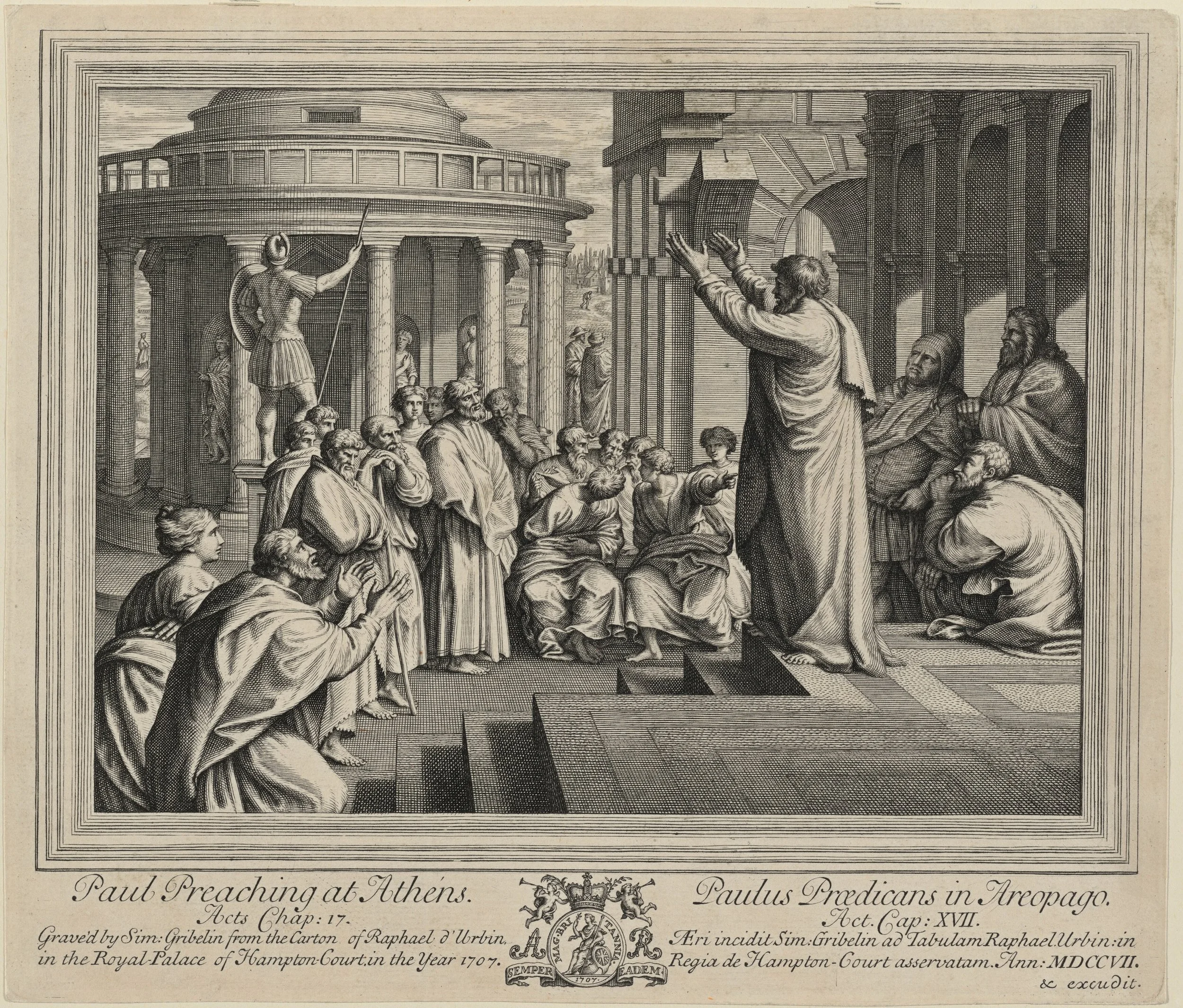
Acts 17:22-31 | Psalm 66:8-20 | 1 Peter 3:13-22 | John 14:15-21
In Acts 17, Paul is travelling across Greece, from Thessalonica (modern-day Thessaloniki) to Beroea (modern-day Veria), and finally, when we arrive at this week’s Lectionary reading in verse 17, Athens. (A quick side note: Google Maps tells me this route covers a distance of 577 kilometers, about 358 miles. All this travel happens in less than 20 verses in this chapter of Acts! It’s worth taking a moment to just consider the time and effort Paul and his companions spent making this journey. Those of us familiar with the New Testament know in theory that Paul travelled across the region, but the compressed narrative of these scriptures makes it easy to gloss over.)
Since arriving in Athens, Paul has been “deeply distressed to see that the city was full of idols,” (verse 16). Eventually, he is brought to the Areopagus, a part of the Acropolis that is often called Mars HIll or the Hill of Ares (Mars and Ares being the Roman and Greek names, respectively, for mythical gods of war). There, he is given an opportunity to speak to the “Epicurean and Stoic philosophers” and all who are gathered.
Idols are serious business in the scriptures. In Exodus 32, when the Israelites create the golden calf (perhaps the most famous and ubiquitous story about an idol), God describes their actions to Moses as “perverse.” In Psalm 97, idols are described as “worthless” and those who serve them are “put to shame.” In Hosea, idolatry is compared to prostitution, both in direct language (Hosea 1:12) and in the ongoing metaphor of the story of Hosea and his unfaithful wife. In 1 Corinthians, idolaters are listed as sinners alongside drunkards and swindlers.
This speech in Act 17 is the first time the scriptures record Paul preaching to a group of people who are neither Jewish nor early Christ-followers. The passage has already told us how upset he is by what he has seen in their city! And so we might expect him to arrive at the Areopagus and express his deep distress with fiery language, outrage, and indignity. But no. He is honest about what the Athenians are getting wrong, but he mostly uses his energy and words to beautifully explain and illustrate the living and active presence of God in the world.
“From one ancestor he made all peoples to inhabit the whole earth, and he allotted the times of their existence and the boundaries of the places where they would live, so that they would search for God and perhaps fumble about for him and find him—though indeed he is not far from each one of us. For ‘In him we live and move and have our being’; as even some of your own poets have said, ‘For we, too, are his offspring,’” (Acts 17:26-28).
In a talk from 2014 titled “How to be Religious in the Public Square,” author and cultural commentator David Brooks describes the spiritual longing that defines much of human experience. He says (in informal, spoken parlance), “We may sit around at gyms. We may watch Kim Kardashian. But human beings were born and blessed with moral imagination, a great longing for ideal holy. All human beings. We all have a longing to lead a good life. A life of transcendence. Some people may not have the categories on how to do that, but they do have a sense that the world, the material world, is incomplete and that they want to surpass the world.”
He goes on to say that Christians can either help or hinder the folks in our lives as they seek to fulfill those spiritual longings, suggesting that our behavior and actions can create either “walls” or “ramps”—barriers to connection with God or paths towards it.
I used to read this passage and scoff at those Athenians with their unknown God. How could someone want to worship something they don’t even understand, can’t even name? But these days, I read about this “unknown god” and recognize a longing for transcendence that is not foolish, but relatable. As many theologians have taught us, we are all wired to worship something. What is an idol but a murky, shadowy, mercurial place to direct our worship? The way I spend my life and time reflects the things I’ve idolized—whether platform or free time or leisure or pleasure or wealth or convenience. I just don’t often recognize it all as worship. Goodness knows Paul had plenty of experience misplacing and misusing his own spiritual zeal; I don’t think we’d be off-base to argue that Saul’s life reflected an idolatry of things like authority, exclusivity, violence, retribution, and purity.
“Whatever your heart clings to and confides in, that is really your god.” —Martin Luther
There are so many ways for God to become unknown to us. The idols of distraction, entertainment, pleasure, and productivity cause us to simply miss God’s divine presence. The idols of patriarchy, consumerism, and order are conflated with God’s character. The idols of greed and wealth obscure God’s redemptive work in the world.
In fact, this passage tells us that before Paul goes to preach at Mars HIll, he first “argued in the synagogue with the Jews and the devout persons,” (verse 17). Those of us who are devout are not immune to idolatry. For the American evangelical church (in which I spent most of my life), the message of Christ is undercut and obscured by the very golden calves we once recognized as perverse, and so believers and unbelievers alike are all left with spiritual longings unmet. Our society would rather worship an unknown god than the gods of power, exclusion, and fear—perhaps rightly so. They want to live, move, and be in communion with love, freedom, and hope—but contrary to the life of Christ, the Christianity of the empire offers none of that.
Similarly, it appears that the Jewish people in Athens had done little to persuade Athenians to abandon their shrines to one god or another. But when Paul is able to acknowledge the deeply-felt spiritual longings of the Athenians, he creates a ramp through which they can begin to direct those longings toward the living God, in Christ, in whom we live and move and have our being. Thanks be to God!