
Exodus 20:1-4, 7-9, 12-20 and Psalm 19 | Isaiah 5:1-7 and Psalm 80:7-15 | Philippians 3:4b-14 | Matthew 21:33-46
Recently, a member of the congregation I serve told me that they are now afraid of the future in a way they have not been before.
Not long before that someone else expressed regret that a public figure had not died. I answered that God does not redeem the world through violence, which they knew to be true. Yet it seems that in times like these we are more likely to return to the instincts embedded in us since the Fall.
Since death wishes come to us naturally, it is no surprise that the Parable of the Wicket Tenants presents us with precisely those. When Jesus turns to the religious leaders who had questioned his authority and asks, “Now when the owner of the vineyard comes, what will he do to those tenants?”, they answer, “He will put those wretches to a miserable death and lease the vineyard to other tenants who will give him the produce at the harvest time.” While, in the scope of the story, it turns out that they judge themselves, it appears violence is all they can think of. And it is how they envision God.
This should not surprise us, for we too believe that our problems can be solved by removing those we judge to be the problem. The idea that life would be easier if it were not for the other(s) comes to us naturally, even though we know this to be naive and know that the clock cannot simply be turned back.
This line of thought robs us of imagination and initiative and fails to understand that we are part of communities large and small which will always have serious disagreements, no matter how many offenders we remove. To somehow believe that ‘putting those wretches to a miserable death’ could be a solution, shows how we believe problems to primarily exist in the other and this demonstrates a remarkable lack of introspection. Without seeking to exonerate the tenants in the parable nor those who have abandoned the common good for power and profit and who take the wrecking ball to established moral and societal consensuses, it appears that a lack of introspection and self-awareness lies at the root of our current malaise.
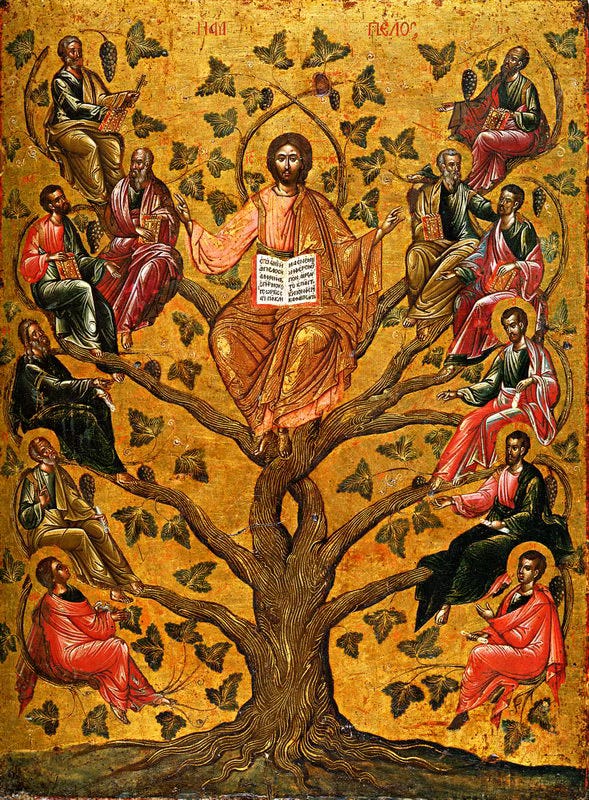
The Parable of the Wicket Tenants is the second of three parables Jesus tells in response to the question about his authority (21:23). Jesus builds the parable on Isaiah’s Song of the Vineyard. In the vineyard the grapes have gone wild, in the parable the tenants have gone wild. And yet despite this echo, the parable is an absurdist story. It is absurdist because who would continue to expose one’s servants to such danger, and who, after the death of one’s servants would risk one’s own son? For the reader the absurdity of the narrative progression of the parable is paralleled with the absurdity of the world being saved through the Cross. But because we have long learned to read the story christologically, we may no longer notice the folly of the owner of the vineyard.
And yet noticing the absurdity of the parable may help us discern the absurdity of the world in which we live, because it is absurd to think that ‘putting those wretches to a miserable death’ could be a solution to anything.
It is absurd to believe that the exercise of power can build trust. I remember a piece in which a representative of an aid organization explained how it was impossible to earn the trust of the local Iraqi population when aid workers were outnumbered by security forces by a ratio of 3 to 1 or more.
It is absurd to permanently be at war and to expect peace.
It is absurd to break agreements and threaten allies and expect this to provide greater influence.
It is as if Jesus tells the parable to illustrate St Paul’s words to the Corinthians, “Do not deceive yourselves. If you think that you are wise in this age, you should become fools so that you may become wise. For the wisdom of this world is foolishness with God.” (1 Cor 3:18-19) Yet the tenants, the religious leaders, expect God to be as they are.
We are given the parable of the Wicket Tenants as we near the end of the liturgical year and contemplate the eschaton. And yet to perceive the parable as a story of violence would be to miss the point because it turns out that this violent text is not violent at all but an invitation into the way of peace, a way the world needs the Church to give witness to. It is an invitation into the way of peace despite the threat of the vineyard to be “given to a people that produces (…) fruits.” (v.43)[1]
The parable of the Wicket Tenants is an invitation into the way of peace, for when the Son who was murdered returns on Easter morning, he comes not to exercise vengeance but to bring forgiveness. The parable is an invitation into the way of peace because God has no pleasure in the death of the wicked, but that the wicked turn from their ways and live. It is an invitation that includes us.
[1]The fruit stands in direct correlation to faith in Jesus, to recognizing the authority of Jesus, the question with which this episode began. (21:23)